

Investing is one of the smartest ways to grow your wealth, but beginners often struggle with one common question mutual funds vs stocks: where to invest?
Both options offer excellent opportunities, but they differ significantly in terms of risk, returns, effort, and control. Choosing the right one depends on your financial goals, knowledge, and risk appetite.
In this guide, we’ll break down everything you need to know about mutual funds vs stocks, helping you decide where to invest in 2026.
- Understanding Mutual Funds and Stocks
- Mutual Funds vs Stocks: Key Differences
- Returns: Which Offers Better Growth?
- Risk: Which is Safer?
- Ease of Investing for Beginners
- Costs & Expenses
- Who Should Invest in Mutual Funds?
- Who Should Invest in Stocks?
- Mutual Funds vs Stocks: Which is Better in 2026?
- Smart Strategy: Combine Both
- Example Portfolio for Beginners
- Future of Investing in 2026
- Conclusion
- FAQs on Mutual Funds vs Stocks
Understanding Mutual Funds and Stocks
What Are Mutual Funds?
Mutual funds are investment vehicles that pool money from multiple investors and invest in a diversified portfolio of assets like stocks, bonds, or other securities. These funds are managed by professional fund managers.
For beginners, mutual funds are often considered a safer and more structured way to enter the market because they offer diversification and expert management.
What Are Stocks?
Stocks represent ownership in a company. When you buy a stock, you own a small portion of that business.
Stock investing allows you to directly benefit from a company’s growth, but it also comes with higher risk due to market volatility and company-specific factors.
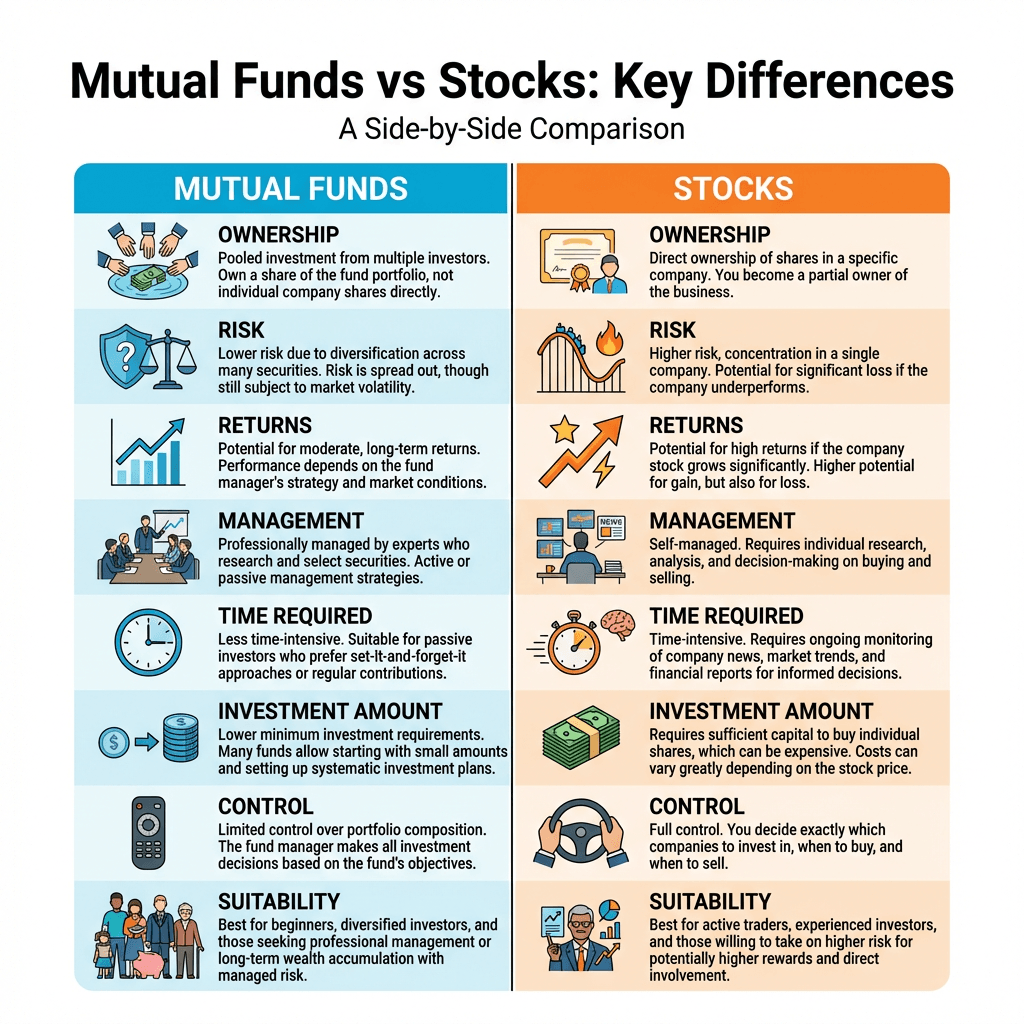
Mutual Funds vs Stocks: Key Differences
To understand where to invest, let’s compare mutual funds vs stocks side by side:
Comparison Table
| Factor | Mutual Funds | Stocks |
| Ownership | Indirect (through fund) | Direct ownership |
| Risk | Lower (diversified) | Higher (single company risk) |
| Returns | Stable & moderate | High but volatile |
| Management | Professional fund managers | Self-managed |
| Time Required | Low (passive) | High (active monitoring) |
| Investment Amount | Start with small SIP | Depends on stock price |
| Control | Limited | Full control |
| Best For | Beginners | Experienced investors |
Mutual funds reduce risk through diversification, while stocks expose you to higher gains and losses.
Returns: Which Offers Better Growth?
When comparing mutual funds vs stocks, returns are a major factor.
- Mutual funds typically offer 10–15% average annual returns over the long term depending on fund type.
- Stocks can generate higher returns, but they are unpredictable and depend on company performance.
While stocks have the potential for “multibagger” returns, many retail investors struggle to consistently beat the market.
Risk: Which is Safer?
Risk is one of the biggest deciding factors when choosing where to invest.
Mutual Funds:
- Diversified across multiple assets
- Lower risk compared to individual stocks
- Suitable for long-term investors
Stocks:
- High volatility
- Company-specific risks
- Requires strong research and knowledge
Mutual funds spread risk across multiple investments, reducing the impact of any single loss.
Ease of Investing for Beginners
If you’re just starting your journey, ease of use matters.
Mutual Funds:
- Simple to start with SIP (Systematic Investment Plan)
- Minimal monitoring required
- Ideal for busy individuals
Stocks:
- Requires market research
- Needs regular tracking
- Learning curve is higher
Many beginners prefer mutual funds because they offer a “hands-free” investing experience.
Costs & Expenses
Understanding costs is essential when deciding mutual funds vs stocks.
Mutual Funds:
- Expense ratio (management fees)
- Exit load in some cases
Stocks:
- Brokerage charges
- Transaction fees
While stocks don’t have management fees, active trading can increase costs significantly.
Who Should Invest in Mutual Funds?
Mutual funds are ideal if you:
- Are a beginner investor
- Prefer low risk
- Don’t have time to track markets
- Want steady long-term growth
- Prefer disciplined investing (SIP)
They are perfect for building wealth gradually with less stress.
Who Should Invest in Stocks?
Stocks are suitable if you:
- Have knowledge of the market
- Can handle high risk
- Want higher returns
- Enjoy researching companies
- Can actively manage your portfolio
Stocks offer more control but demand more responsibility.
Mutual Funds vs Stocks: Which is Better in 2026?
There is no one-size-fits-all answer.
According to experts, the choice depends on your:
- Risk tolerance
- Investment goals
- Time commitment
- Knowledge level
Best Approach for Beginners:
Start with mutual funds and gradually learn stock investing.
Many successful investors combine both for balanced growth.
Smart Strategy: Combine Both
Instead of choosing one, consider a hybrid approach:
- 70% Mutual Funds → Stability & diversification
- 30% Stocks → High growth potential
This strategy helps you balance risk and reward effectively.
Example Portfolio for Beginners
| Investment Type | Allocation |
| Mutual Funds (SIP) | 60–70% |
| Blue-chip Stocks | 20–30% |
| Cash / Emergency Fund | 10% |
Future of Investing in 2026
The investment landscape is evolving rapidly:
- More people are investing through SIPs
- Digital platforms are making investing easier
- Financial awareness is increasing globally
Beginners are increasingly choosing mutual funds as their entry point into investing.
Conclusion
When it comes to mutual funds vs stocks, the right choice depends on your personal financial journey.
- Mutual funds are ideal for beginners seeking stability and simplicity
- Stocks are better for those willing to take risks and actively manage investments
If you’re still wondering where to invest, the safest approach is to start small, stay consistent, and keep learning.
Remember, investing is not about quick profits it’s about long-term wealth creation.
At Next Insight Technologies, we simplify complex financial concepts to help you make smarter decisions. Whether you’re exploring mutual funds vs stocks or learning where to invest, our goal is to provide clear, practical, and actionable insights.
Stay connected with us for the latest updates on finance, technology, and smart investing strategies.
FAQs on Mutual Funds vs Stocks
Mutual funds are generally better for beginners due to lower risk and professional management.
Yes, combining both can help balance risk and maximize returns.
They are relatively safer than stocks due to diversification, but still subject to market risks.
Stocks can offer higher returns, but they come with higher risk and volatility.
You can start mutual funds with as low as ₹100–₹500, while stocks depend on share prices.
For beginners, SIP is better as it promotes disciplined and low-risk investing.
Start with mutual funds for stability, and gradually add stocks as you gain experience.

