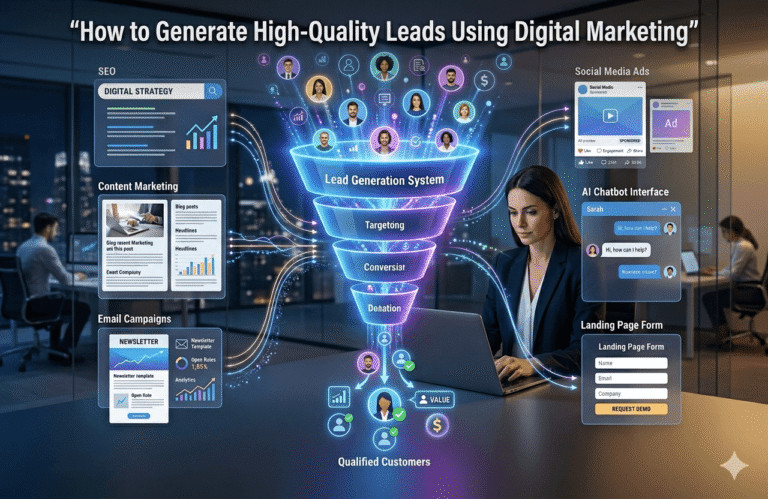
Every business wants more customers. But here is the truth most marketing guides skip over: more leads does not always mean better leads. A pipeline full of unqualified contacts wastes your time, drains your budget, and demoralizes your sales team. What you actually need is a steady, predictable flow of high-quality leads generation – people who are genuinely interested in what you offer and are ready to take action.
The good news is that digital marketing in 2026 gives you more precise tools than ever to attract exactly the right audience. The challenge is knowing which strategies deliver real results versus which ones just generate noise. This guide cuts through the clutter and walks you through the most effective, proven methods for how to generate leads online – backed by real data and built for the way buyers actually behave today.
- Why Lead Quality Matters More Than Lead Volume in 2026
- 61%
- 79%
- 14.6%
- 3x
- 1. Search Engine Optimisation (SEO) – Your Highest-Converting Channel
- 2. Content Marketing and Lead Magnets
- 3. Email Marketing – Still the Highest-ROI Channel
- 4. Social Media and Paid Advertising for Lead Generation
- 5. AI Chatbots and Marketing Automation
- Best Lead Generation Channels Compared: Performance at a Glance
- 6. Landing Page Optimisation: Where Traffic Becomes Leads
- FAQs: How to Generate High-Quality Leads with Digital Marketing
Why Lead Quality Matters More Than Lead Volume in 2026
Before diving into tactics, it is worth understanding the landscape. The numbers below reveal a clear picture: most businesses are generating leads, but far fewer are converting them into customers – and that gap comes down to quality, not quantity.
61%
of marketers say generating high-quality leads is their biggest challenge (HubSpot, 2026)
79%
of marketing leads never convert into sales due to poor nurturing and qualification
14.6%
close rate for SEO-driven leads vs. just 1.7% for outbound leads (SalesHive, 2024)
3x
more leads generated by content marketing vs. outbound, at 62% lower cost (Demand Metric)
These numbers point to a critical insight: the channel you use to attract leads matters enormously. Inbound strategies – SEO, content, email – consistently outperform outbound tactics on both cost per lead and conversion rate. With that foundation in mind, let us look at the strategies that actually work.
1. Search Engine Optimisation (SEO) – Your Highest-Converting Channel
If you want to know how to generate leads online with the best long-term return, SEO is your answer. Organic search leads close at a rate of 14.6% – nearly nine times higher than outbound approaches. That is because people arriving via search are already looking for exactly what you offer. They have intent. Your job is simply to be visible when they search.
Effective lead-generating SEO in 2026 revolves around three pillars. First, target the right keywords – specifically, long-tail keywords that signal buying intent. Instead of ranking for “digital marketing,” aim for “best digital marketing agency for small businesses in Mumbai.” The search volume is lower, but the lead quality is dramatically higher because the person knows what they want.
Second, create content that answers real questions your audience types into Google. Educational blog posts, how-to guides, and comparison articles all attract readers who are actively researching a purchase decision. Third, ensure your technical SEO foundations are solid – fast loading speed, mobile responsiveness, and clean site structure. In 2026, search engines reward genuine expertise, authoritativeness, and trustworthiness (Google’s E-E-A-T framework), so thin or AI-generated filler content simply will not rank.
2. Content Marketing and Lead Magnets
Content marketing is the engine that powers high-quality leads generation across virtually every digital channel. The principle is straightforward: create genuinely useful content that addresses your audience’s real problems, and in exchange for access to your most valuable resources, ask for their contact details.
These contact-detail exchanges are called lead magnets, and the format matters enormously. According to the 2026 Content Marketing Institute report, AI-personalized checklists achieve an 11.4% conversion-to-sale rate within a 30-day nurture window – more than double the 4.7% rate for long-form PDF guides. Short, specific, and immediately actionable lead magnets consistently outperform lengthy e-books that nobody actually reads.
Effective lead magnet formats for 2026 include targeted checklists, industry-specific templates, free mini-courses, interactive quizzes, and short video training series. The key is specificity – a checklist titled “10-Step SEO Audit for Indian E-Commerce Stores” will outperform “The Complete Guide to Digital Marketing” every single time, because it speaks directly to a defined audience with a specific problem.
Interactive content deserves special attention here. Research shows interactive content generates twice the conversions and five times more pageviews than static content. Quizzes, assessments, and calculators that deliver a personalized result in exchange for an email address are among the best lead generation techniques 2026 has produced.
3. Email Marketing – Still the Highest-ROI Channel
Despite every prediction of its demise, email marketing continues to deliver an extraordinary return: $36 for every $1 invested. For lead generation specifically, a well-structured email strategy does two critical jobs – it captures new leads through subscription forms and lead magnets, and it nurtures existing leads until they are ready to buy.
The nurturing side is where most businesses leave money on the table. Companies that implement lead nurturing via email generate 50% more sales-ready leads while spending 33% less. The mechanics are simple: when someone downloads your lead magnet or signs up for your newsletter, they enter an automated email sequence that delivers value, builds trust, and progressively moves them toward a purchase decision. According to Omnisend’s 2026 research, automated email campaigns demonstrate a staggering 2,361% higher conversion rate than non-automated campaigns.
Personalization is the differentiating factor in 2026’s crowded inbox. Emails with personalized subject lines perform measurably better, with 66% of recipients more likely to open an email that includes their name or company. Segmenting your list by industry, behaviour, or funnel stage and tailoring your messaging accordingly is no longer optional – it is the baseline expectation of any serious lead generation programme.
4. Social Media and Paid Advertising for Lead Generation
Social media platforms have matured into sophisticated lead generation engines, particularly for reaching audiences who are not yet actively searching for your product but match your ideal customer profile. When integrated into a broader high-quality leads generation strategy, paid social and organic social work together to build awareness and capture intent.
LinkedIn stands out dramatically for B2B lead generation – it is 277% more effective at generating leads than Facebook or X (formerly Twitter). For B2B businesses, LinkedIn’s native Lead Gen Forms allow prospects to submit their details without ever leaving the platform, dramatically reducing friction. The ROI from organic LinkedIn activity alone averages 229% across industries, making it one of the most underutilised channels for professional services businesses.
For B2C or mixed-audience businesses, Meta’s lead generation ads (Facebook and Instagram) offer unmatched targeting precision. Following up with a lead within five minutes of them submitting a form makes you nine times more likely to convert them – which means pairing your paid social campaigns with automated CRM workflows is not a nice-to-have; it is essential.
5. AI Chatbots and Marketing Automation
One of the most impactful best lead generation techniques 2026 practitioners are deploying right now is the combination of AI chatbots and marketing automation. Chatbots have evolved far beyond scripted FAQ responders. Today’s AI-powered conversational tools can qualify visitors, answer product-specific questions, book appointments, and capture contact details – all at 2 a.m. on a Sunday, without human intervention.
The results back this up: 64% of businesses using AI chatbots report an increase in qualified leads, and real-time interaction has boosted conversion rates by up to 20% in B2B settings. Businesses that use marketing automation for nurturing see a 451% increase in qualified leads compared to those managing campaigns manually. That is not a marginal improvement – it is a complete transformation of what a lean marketing team can accomplish.
The most effective automation workflows in 2026 connect your traffic sources (website, social media, email) to your CRM in real time, score leads automatically based on their behaviour and profile, route hot leads to sales immediately, and place cooler leads into targeted nurture sequences. This removes the bottleneck between generating interest and generating revenue.
Best Lead Generation Channels Compared: Performance at a Glance
Not all lead generation channels perform equally. The table below compares the most widely used digital marketing channels across key performance factors to help you prioritize your investment.
| Channel | Lead Quality | Cost per Lead | Close Rate | Time to Results | Best For |
|---|---|---|---|---|---|
| SEO / Organic Search | Very High | Low (long-term) | 14.6% | 3–6 months | All business types |
| Content Marketing | High | 62% lower than outbound | High | 2–4 months | B2B, SaaS, Services |
| Email Marketing | High | Very Low | $36 ROI per $1 | Immediate | Nurturing, Re-engagement |
| LinkedIn Organic | Very High | Low | 229% ROI average | 1–3 months | B2B, Professional Services |
| Paid Social (Meta/LinkedIn) | Medium | Medium–High | Medium | Immediate | B2C, Brand Awareness |
| Google PPC Ads | Medium–High | High ($70.11 avg CPL) | 26% MQL-to-SQL | Immediate | High-intent buyers |
| AI Chatbots / Automation | High | Low | +20% conversion lift | Immediate (24/7) | All business types |
| Outbound (Cold Email / Calls) | Low | Medium | 1.7% | Immediate | B2B prospecting only |
6. Landing Page Optimisation: Where Traffic Becomes Leads
Even the best traffic sources fail if your landing page is not built to convert. A landing page is where your digital marketing efforts either pay off or fall apart – and the data shows most businesses have significant room for improvement here.
The average landing page conversion rate across all industries is 9.7%, but top-performing pages routinely exceed 20–30%. The difference comes down to a handful of factors. Clear, benefit-focused headlines that speak directly to the visitor’s problem. A single, focused call-to-action – not four different options pulling attention in different directions. Social proof in the form of testimonials, client logos, or case study results. And a form that asks for only what is necessary – every additional field you add reduces completions.
Video on landing pages deserves special mention. Adding a short, relevant explainer video can increase conversions by up to 86%. In 2026, multi-step conversational forms – where questions appear one at a time rather than all at once – show a 49.3% higher completion rate than traditional single-page forms. Small changes to your landing page architecture can have an outsized impact on your overall high-quality leads generation results.
Conclusion
Generating more leads is not the goal – generating the right leads is. The proven strategies covered in this guide – SEO, content marketing with targeted lead magnets, email nurturing, social media, AI chatbots, and landing page optimisation – all share a common principle: they attract people who already have a reason to be interested in what you offer. That is what separates high-quality leads generation from simply driving traffic.
You do not need to implement all of these strategies simultaneously. Start by identifying your biggest current gap: Is your traffic low? Focus on SEO and content. Are visitors arriving but not converting? Work on your landing pages and lead magnets. Are leads coming in but not closing? Build your email nurturing sequences. Address one layer at a time, measure results honestly, and let the data guide your next move. The best lead generation techniques 2026 has to offer are not magic formulas – they are consistent, intentional actions applied with clarity and patience.
Next Insight Technologies is a trusted digital media platform delivering expert-driven content across Digital Marketing, Technology, Business, Finance, Health, Travel, and more. Our editorial team is committed to producing accurate, well-researched, and actionable content that helps entrepreneurs, marketers, and business owners navigate the fast-changing digital landscape.
Whether you are building your first lead generation funnel or optimizing an established digital marketing strategy, we are here to help you make smarter, data-driven decisions. Explore our full library at nextinsighttech.com and visit our Digital Marketing section for more guides like this one.
FAQs: How to Generate High-Quality Leads with Digital Marketing
High-quality lead generation is the process of attracting potential customers who have a genuine interest in your product or service and are likely to convert into paying customers. Unlike volume-based lead generation, it focuses on relevance, intent, and fit – meaning the leads you capture are pre-qualified based on their behaviour, demographics, and the channel through which they found you.
The most effective way to generate leads online in 2026 is through a combination of SEO-driven content marketing and targeted lead magnets. This combination attracts high-intent visitors via organic search and converts them using valuable, specific free resources. Pairing this with automated email nurturing and AI chatbots creates a system that works 24/7 without constant manual effort.
SEO typically takes between 3 to 6 months to produce consistent lead generation results, depending on your industry competition, domain authority, and content quality. While it requires patience upfront, SEO leads close at a rate of 14.6% – nearly nine times higher than outbound leads – making it the highest-converting long-term investment in digital marketing.
LinkedIn is by far the most effective social media platform for B2B lead generation. It is 277% more effective at generating leads than Facebook or X (formerly Twitter), and organic activity on LinkedIn delivers an average ROI of 229% across industries. LinkedIn’s Lead Gen Forms, which allow users to submit details without leaving the platform, are particularly powerful for reducing friction in the conversion process.
A good website lead conversion rate for B2B businesses is between 2% and 5%, while top-performing landing pages can reach 10% or above. The average landing page conversion rate across all industries is 9.7%. If your rate is below 2%, focus on improving your call-to-action clarity, reducing form fields, adding social proof, and testing conversational multi-step form formats.
Email marketing generates high-quality leads through two mechanisms: lead capture (offering valuable free resources in exchange for an email address) and lead nurturing (sending targeted, personalized sequences that build trust over time and move subscribers toward a purchase decision). Companies that implement proper lead nurturing via email generate 50% more sales-ready leads at 33% lower cost than those without a nurturing strategy.
Yes – significantly. 64% of businesses using AI chatbots report an increase in qualified leads, and real-time chatbot interaction has been shown to boost conversion rates by up to 20% in B2B settings. Modern AI chatbots can qualify visitors, answer specific questions, book appointments, and capture contact details around the clock – making them one of the most cost-effective tools for scaling lead generation without expanding headcount.