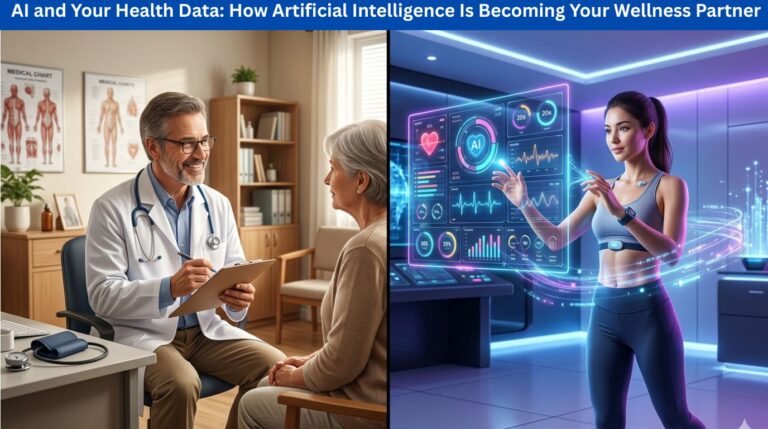
Think back just five years. If you wanted to know whether your heart was beating irregularly, you booked a doctor’s appointment, waited, wore a Holter monitor for 24 hours, and got results days later. Today, a slim ring on your finger or a watch on your wrist can flag an irregular rhythm in real time before you even feel a symptom. That is not science fiction. That is AI health monitoring 2026, and it is reshaping the entire concept of personal wellness.
Artificial intelligence is no longer hidden inside hospital mainframes or research labs. It now lives in the devices we wear, the apps we open every morning, and increasingly, in the platforms that connect us to our doctors. This post unpacks exactly how AI is becoming a true wellness partner from wearable trackers and symptom checkers to fully personalized care plans and what you should know before trusting it with your most sensitive data: your health.
- The Scale of the Shift: Key Numbers for 2026
- 94%
- 66%
- $110B
- 42%
- What Is AI Health Monitoring, and How Does It Work?
- The Rise of the Wearable AI Health Tracker
- AI-Powered vs. Traditional Health Monitoring: A Direct Comparison
- AI Personalized Healthcare: Moving from One-Size-Fits-All to One-Size-Fits-You
- The AI Symptom Checker and Health Data: More Than a Search Engine
- Privacy, Ethics, and What You Should Know Before Sharing Your Data
- Frequently Asked Questions (FAQs)
The Scale of the Shift: Key Numbers for 2026
Before exploring how the technology works, it helps to understand just how fast it is spreading. These numbers paint a clear picture of an industry that has crossed the tipping point from experimentation to mainstream adoption.
94%
of healthcare organizations now consider AI essential to their operations (Demand Sage, 2026)
66%
of physicians actively used health AI in 2024 — up 78% from just 38% in 2023
$110B
projected global AI-in-healthcare market size by 2030, growing at 38.6% CAGR
42%
reduction in diagnostic errors reported by AI-supported hospitals vs. non-AI facilities
These figures underscore a simple truth: the integration of AI into healthcare is no longer optional or fringe. It is the new foundation on which modern wellness is being built.
What Is AI Health Monitoring, and How Does It Work?
AI health monitoring 2026 refers to the use of artificial intelligence algorithms to continuously collect, analyze, and interpret biometric data either in real time or on a rolling basis to support better health decisions. Unlike traditional healthcare, which captures a brief snapshot during an annual check-up, AI-powered monitoring creates a living, breathing picture of your physiology that evolves 24 hours a day.
At its core, the process works in four steps. First, sensors on a wearable device or connected medical tool collect raw physiological signals heart rate, blood oxygen, skin temperature, respiration rate, blood glucose, and more. Second, those signals are transmitted to a processing layer, either on the device itself (called “edge AI”) or in the cloud. Third, machine learning algorithms analyze the data against your personal baseline and broader population patterns. Finally, the system delivers an alert, recommendation, or insight directly to you or, in clinical settings, to your care team.
The Rise of the Wearable AI Health Tracker
Perhaps the most visible face of this revolution is the wearable AI health tracker. Devices like the Apple Watch Series 11, Oura Ring 4, Fitbit Charge 6, Garmin Fenix 8, and Samsung Galaxy Watch 7 have evolved dramatically from their step-counting ancestors. Today’s top models are essentially miniaturized health clinics strapped to your wrist or finger.
What separates a wearable AI health tracker from a basic fitness band is the intelligence layered on top of the raw sensor data. Where a simple tracker tells you how many steps you took, an AI-powered device tells you why your recovery score is lower today (you slept poorly after a late meal), predicts when you might be approaching overtraining, or flags a blood oxygen drop that might warrant medical attention. The Oura Ring 4, for example, uses AI to generate daily “readiness” and “sleep” scores that synthesize dozens of individual metrics into a single, actionable number. Garmin’s Body Battery feature does something similar for energy management, drawing on heart rate variability, stress levels, and sleep quality simultaneously.
According to BCG research published in early 2026, close to half of US adults already use health apps, and roughly one-third use a wearable device that tracks their health metrics. Healthcare providers are beginning to incorporate this data pulled directly from patients’ personal devices into clinical decision-making, creating a feedback loop between consumer wellness tech and professional medical care.
AI-Powered vs. Traditional Health Monitoring: A Direct Comparison
Understanding the practical difference between conventional health tracking and today’s AI-driven approach helps clarify what makes the technology genuinely useful and where its limitations still lie.
| Feature / Criteria | Traditional Health Monitoring | AI-Powered Health Monitoring (2026) |
| Data Frequency | Periodic (annual check-up, scheduled tests) | Continuous – 24/7 real-time tracking |
| Personalization | General population benchmarks | Individual baselines; adapts over time |
| Early Detection | Symptoms usually present before diagnosis | Can detect changes 24–48 hours before symptoms emerge |
| Access & Convenience | Requires clinic visit or scheduled test | On-device, app-based, available anywhere |
| Cost Over Time | High (repeated clinic visits, lab fees) | Lower long-term cost; reduces unnecessary visits |
| Chronic Disease Management | Reactive – acts after condition worsens | Proactive – continuous alerts and coaching |
| Data Sharing with Doctors | Manual records, paper reports | Seamless digital sync with EHR and telehealth platforms |
| Mental Health Monitoring | Self-reporting, scheduled sessions | Digital phenotyping detects risk patterns with up to 85% accuracy before clinical onset |
| Privacy Risks | Lower – data stays in clinical records | Higher – requires robust encryption and clear consent policies |
| Accuracy for Diagnostics | High for confirmed diagnoses | Strong for detection; expert physician still needed for interpretation |
AI Personalized Healthcare: Moving from One-Size-Fits-All to One-Size-Fits-You
One of the most meaningful promises of artificial intelligence in medicine is AI personalized healthcare the ability to tailor prevention, diagnosis, and treatment to the individual, not the average. For decades, clinical guidelines were built on population studies that, by definition, describe the average patient. You, however, are not average. Your metabolism, genetics, stress patterns, sleep architecture, and gut microbiome are uniquely yours.
AI changes the calculus. By continuously analyzing your specific data over weeks and months, AI systems can identify what is normal for you your resting heart rate, your optimal sleep duration, your typical stress response curve and flag meaningful deviations from your personal baseline. This is fundamentally different from comparing you against a chart that was built from studies of other people.
In practice, AI personalized healthcare already shows up in several ways. Google recently announced integration between Fitbit and personal medical records, allowing the platform’s AI health coach to offer guidance based on a user’s actual lab results and medication history not generic advice. Platforms like Prenuvo combine whole-body imaging, advanced bloodwork, and continuous biometric data into a membership model that tracks an individual’s health trajectory over time. Insulin management apps using continuous glucose monitors are adjusting dosage recommendations based on a diabetic patient’s specific glycemic patterns, reducing hypoglycemic episodes by up to 30% in some clinical studies.
The AI Symptom Checker and Health Data: More Than a Search Engine
Many people have already used a basic online symptom checker type in your symptoms, get a list of possible conditions. The newer generation of AI symptom checker and health data tools is categorically more sophisticated. Rather than running a keyword search against a database, modern AI symptom checkers use natural language processing and machine learning to weigh your symptoms against your personal health history, current medications, age, location (for epidemiological context), and even recent biometric readings from your wearable device.
The result is a risk assessment that is far more contextually relevant than anything a generic symptom list can provide. Some platforms already allow users to sync medical records, wearable data, and reported symptoms into a unified AI model that can surface potential concerns before a doctor’s appointment giving both patient and clinician a richer starting point for the conversation.
It is important to be clear-eyed about limitations here. AI symptom checkers are tools for informed awareness, not clinical diagnosis. A meta-analysis of 83 studies found that generative AI models achieved an overall diagnostic accuracy of around 52% comparable to a non-specialist physician, but well below that of a domain expert. The technology is most valuable as a bridge that helps patients ask better questions and helps clinicians act on richer data.
Privacy, Ethics, and What You Should Know Before Sharing Your Data
The power of AI health monitoring comes with a significant responsibility: your health data is among the most sensitive information that exists about you. Before you sync a wearable or upload your medical records to an AI platform, there are a few things worth understanding.
First, understand where your data goes. Reputable platforms like Apple Health, Google Fit, and Fitbit have published privacy policies that limit third-party data sharing and store health information in encrypted form. Less established apps may monetize your data in ways that are not immediately obvious. Always check whether the platform is HIPAA-compliant (in the US) or meets equivalent regulatory standards in your country.
Second, recognize the difference between wellness data and medical-grade data. Many consumer wearable readings including ECG results are FDA-cleared for informational purposes but are not the same as a clinical-grade test performed in a hospital setting. They are valuable for trend detection, not definitive diagnosis.
Third, your data is most useful when shared with your actual care team. AI identifies patterns; trained clinicians interpret them in the context of your full health picture. The two working together what BCG calls an “AI co-pilot” model consistently outperforms either alone.
Conclusion
Artificial intelligence is not replacing the doctor-patient relationship – it is deepening it. The days of waiting a year between health snapshots are giving way to a continuous, personalized, data-rich model of wellness that catches problems earlier, tailors advice more precisely, and puts more control in the hands of the individual. Whether through a wearable AI health tracker on your wrist, an AI symptom checker connected to your medical history, or an AI personalized healthcare platform that learns your unique physiology over months and years, the technology is rapidly becoming less of a novelty and more of a necessity.
The most important thing you can do right now is stay informed, choose trustworthy platforms, keep your care team in the loop, and remember that AI is a powerful partner – not an infallible oracle. Used wisely, it may be one of the most significant health tools available to you in 2026 and beyond.
Next Insight Technologies is a trusted digital media platform delivering expert-driven content across Health, Technology, Finance, Digital Marketing, Travel, and more. Our editorial team is committed to producing well-researched, SEO-friendly, and genuinely useful content that helps readers navigate the fast-changing landscape of modern life.
From practical wellness guides to the latest tech trends, we believe that good information presented clearly and honestly can make a real difference in how people live and make decisions. Explore our full library at nextinsighttech.com, and visit our Health section for more articles like this one.
Frequently Asked Questions (FAQs)
AI health monitoring uses artificial intelligence to continuously collect, analyze, and interpret biometric data from wearables, apps, and connected devices. In 2026, it is widely used for real-time heart rate analysis, sleep quality tracking, early disease detection, chronic condition management, and personalized wellness coaching – often integrating directly with telehealth platforms and electronic health records.
Modern wearable AI health trackers are increasingly accurate for trend detection and general wellness monitoring. Many, like the Apple Watch Series 11, carry FDA clearances for specific features such as ECG and irregular heart rhythm detection. However, they are not substitutes for clinical-grade medical tests. They are best used as early-warning tools that prompt conversations with healthcare professionals.
Standard healthcare applies population-level guidelines to every patient. AI personalized healthcare builds an individual model based on your unique biometrics, genetics, history, and lifestyle data – allowing recommendations, risk assessments, and treatment plans that are specifically tailored to you rather than the statistical average patient.
AI symptom checkers are valuable tools for informed awareness, not definitive diagnosis. They can help you understand risk levels and ask better questions before a medical appointment. Current AI models achieve roughly 52% diagnostic accuracy in research settings – comparable to a general practitioner but below that of a specialist. Always consult a qualified healthcare provider for any medical concern.
Reputable platforms use encryption, follow HIPAA (US) or equivalent regional regulations, and publish clear data-use policies. The key steps to protect yourself are: choose platforms with strong privacy credentials, review permissions carefully, avoid apps that share data with third-party advertisers, and always check whether your specific platform is compliant with health data regulations in your country.
For most everyday users, the Fitbit Charge 6 offers an excellent balance of accurate tracking, long battery life, cross-platform compatibility, and AI-driven Google coaching at an accessible price. For those prioritizing sleep and recovery, the Oura Ring 4 is a top choice. Apple Watch Series 11 remains the gold standard for iPhone users who want the most comprehensive health feature set.
Yes – and this is one of the most impactful applications of the technology. AI-powered continuous glucose monitors can predict and alert users to dangerous blood sugar swings and recommend insulin adjustments in real time. For heart patients, wearables continuously monitor rhythm and flag abnormalities before they escalate. Studies show AI-guided remote patient monitoring has cut 30-day hospital readmissions by as much as 70% in some health systems.